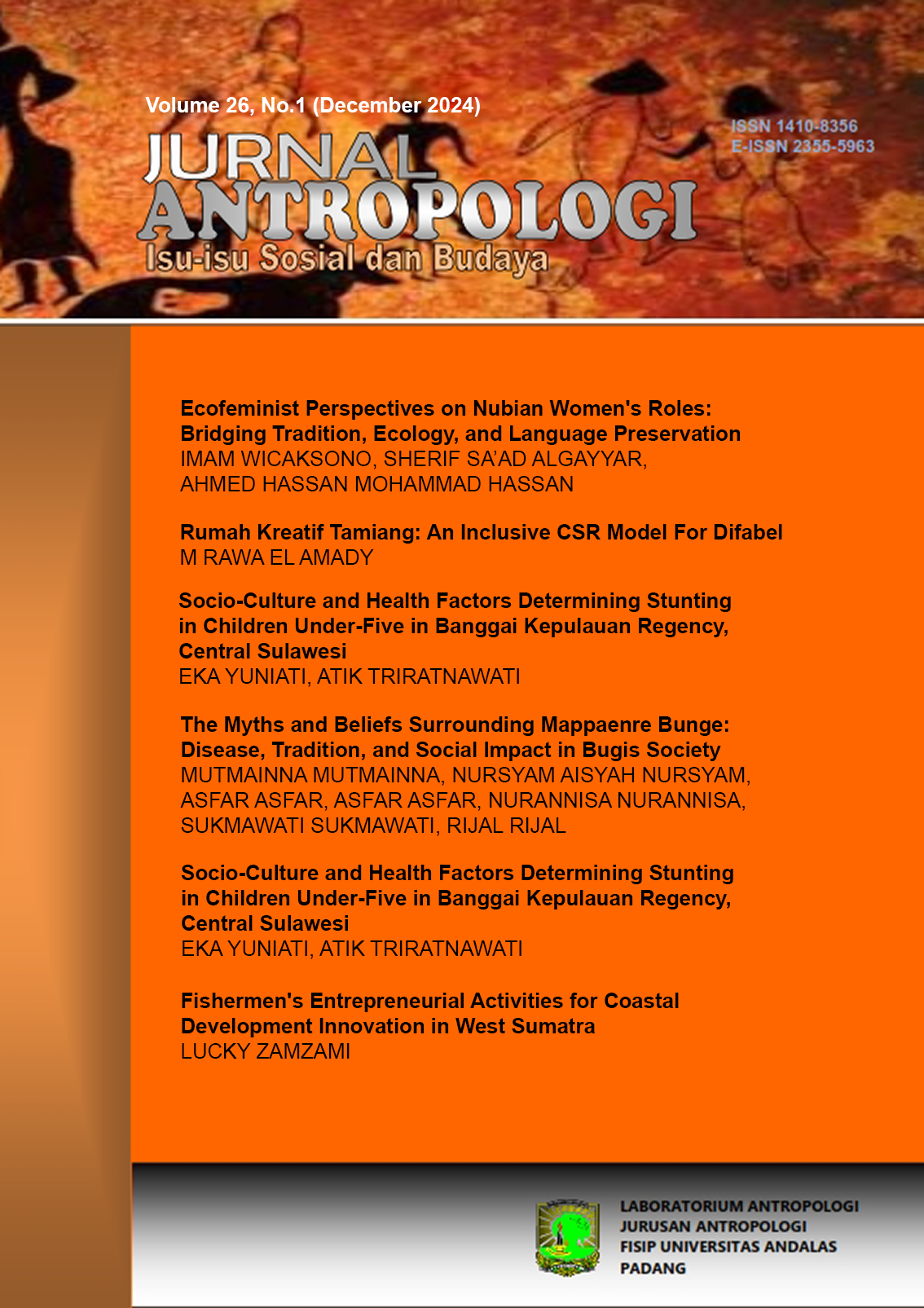
Ecofeminist Perspectives on Nubian Women's Roles: Bridging Tradition, Ecology, and Language Preservation
DOI:
https://doi.org/10.25077/jantro.v26.n2.p229-240.2024Keywords:
Ecofeminism, Nubian women, cultural resilience, ecological sustainability, language preservationAbstract
This study integrates viewpoints from Vandana Shiva and Maria Mies to investigate Nubian women's responsibilities as agents of cultural, ecological, and linguistic sustainability within an ecofeminist framework. Three interconnected aspects are the subject of the study: their contributions to language preservation, ecological management, and cultural traditions. This study synthesizes knowledge from academic sources on Nubian women's adaptive tactics in the face of socio-ecological disturbances, including the relocation caused by the Aswan High Dam, through a qualitative literature review and thematic analysis. According to the research, Nubian women preserve intangible cultural heritage by striking a balance between modernity and customs like storytelling, rituals, and crafting. Their ecological roles, which include resource management, the use of natural materials, and sustainable agriculture techniques, show how important they are to preserving environmental equilibrium. Linguistically, Nubian women preserve their language through folklore, songs, and everyday communication, ensuring intergenerational transmission of cultural identity. This research underscores the interconnectedness of gender, culture, and ecology, providing a model for cultural resilience and sustainability in marginalized communities globally. The implications extend to broader discussions on sustainable development, gender studies, and strategies for integrating localized resilience into global challenges.References
Badawi, J. A. (1971). The status of women in Islam. Al-Lttihad, 8(2). https://www.iium.edu.my/deed/articles/statusofwomen.html
Dano, C. P. (2021). Perilaku Komunikasi Suku Pedalaman Polahi dalam Berinteraksi dengan Masyarakat Luar Suku. MEDIALOG: Jurnal Ilmu Komunikasi, 4(1), 1–9. https://doi.org/10.35326/medialog.v4i1.825
Douki, S., Nacef, F., Belhadj, A., Bouasker, A., & Ghachem, R. (2003). Violence against women in Arab and Islamic countries. Archives of Women’s Mental Health, 6(3), 165–171. https://doi.org/10.1007/s00737-003-0170-x
Eliade, M. (1959). The Sacred and The Profane – The Nature of Religion, Translated from the French by Willard R.Trask. A Harvest Book Harcourt, Brace & World Inc.
Firdaus, M. A. (2022). Kesetaraan Gender dalam Perspektif Hukum Islam dan HAM. Rahma.Id, 1. https://rahma.id/kesetaraan-gender-dalam-perspektif-hukum-islam-dan-ham/
Galuwo, K. (2017). Sunat Perempuan di Gorontalo, Bersimpang Tradisi dan Resiko. Lokadata.Id, 1. https://lokadata.id/artikel/sunat-perempuan-di-gorontalo-bersimpang-tradisi-dan-risiko
Hairiri, R. (2020). Tradisi Khataman Al-Qur’an Pasangan Pengantin Pada Acara Pernikahan Di Desa Teluk Tigo Kecamatan Cermin Nan Gedang Kabupaten Sarolangun Provinsi Jambi (Kajian Studiliving Al-Qur’an). (Thesis) Universitas Islam Negeri Sulthan Thaha Saifuddin Jambi.
Hulwati, H. (2015). Memahami Kesetaraan Gender Dalam Fiqh: Analisis Teori Evolusi Kontinuitas Fiqh. Kafa`ah: Journal of Gender Studies, 5(1), 22. https://doi.org/10.15548/jk.v5i1.112
Hunowu, M. A. (2020). Linula molalahu (H. B. Pakuna (ed.)). Insan Cendekia Mandiri.
Hunowu, M. A., Lampe, M., & Idrus, N. I. (2022). From Sacred To Profane : Efforts To Control The Corn Pests In Gorontalo , Indonesia. Journal of Sustainability Science and Management, 17(5), 117–132. https://doi.org/10.46754/jssm.2022.05.009
Hunowu, M. A., Pakuna, H. B., Husain, R. T., & Sery, I. D. (2022). Revitalizing Local Cultural Values in Preventing Sexual Violence. Prosiding Konferensi Nasional Gender Dan Gerakan Sosial, 01(01), 83–94. https://proceedings.radenfatah.ac.id/index.php/kggs/article/view/182
Johari, H. (2019). Kekerasan Seks Serdadu Belanda. Historia.Id, 2. https://historia.id/militer/articles/kekerasan-seks-serdadu-belanda-vZX1o/page/2
Johari, H. (2022). Kejahatan Seks Serdadu Belanda dalam Catatan Sejarah. Merdeka.Com, 1. https://www.merdeka.com/histori/opini-kejahatan-seks-serdadu-belanda-dalam-catatan-sejarah.html
Kau, S., & Dkk. (2014). Sejarah Sosial Ulama Gorontalo; Studi tentang Potret dan Peran Tokoh Islam di Gorontalo.
Ma’ruf, Y. T., & Berahim, A. (n.d.). Silsilah Arab Pegon Gorontalo dan Data dari Belanda. https://upload.wikimedia.org/wikipedia/commons/a/a1/Daftar_Raja_-_Raja_Gorontalo.jpg
Peterson, J. B. (2018). 12 Rules for Life: An Antidote to Chaos. Penguin Random House.
Pomalingo, S. (2015). Polahi: Komunitas Pedalaman Suku Gorontalo. Cultura: Jurnal Dinamika Sosial Dan Budaya, 1(2), 53–62. https://repository.ung.ac.id/get/kms/11052/POLAHI-KOMUNITAS-PEDALAMAN-SUKU-GORONTALO.pdf
Rawandhy, I., Hula, N., & Mariana, A. (2020). The Beati Tradition in North Gorontalo District ( Ethnographic Study of Processions and Verbal Meanings of Tuja ’ i ) Tradisi Beati di Kabupaten Gorontalo Utara ( Studi Etnografi terhadap Prosesi dan Makna Verbal Tuja ’ i ). Al-Ulum, 20(1), 295–315. https://doi.org/https://doi.org/10.30603/au.v20i2.1743
Rismadona, R. (2019). Proses Adat Perkawinan Masyarakat Di Kabupaten Mukomuko Propinsi Bengkulu. JURNAL PENELITIAN SEJARAH DAN BUDAYA. https://doi.org/10.36424/jpsb.v3i1.116
Rosyidah, R. A. (2018). Pandangan Islam tentang Kesetaraan Gender. Bimbinganislam.Com, 1. https://bimbinganislam.com/pandangan-islam-tentang-kesetaraan-gender/
Sarpinah, Salimin, A. S. P. (2018). Nilai-Nilai Yang Terkandung Dalam Budaya Mappacci Pada Rangkaian Pelaksanaan Perkawinan Orang Bugis. SELAMI IPS.
Sulusiyah. (2020). Pandangan Islam terhadap Kesetaraan Gender. Nuruljadid,Net, 1. https://www.nuruljadid.net/9574/pandangan-islam-terhadap-kesetaraan-gender
Supardan, D. (2008). Menyingkap Perkembangan Pendidkan Sejak Masa Kolonial Hingga Sekarang: Perspektif Pendidikan Kritis. Generasi Kampus, 1(2), 96–106. https://jurnal.unimed.ac.id/2012/index.php/gk/article/view/6941
Supriani, E. (2019). Tradisi Khatam Al-Qur’an Pada Pernikahan Suku Bugis Di Palembang (Studi Kasus di 3 Ilir Palembang). UIN Raden Patah Palembang.
Suwardi, A. C., & Rosydiana, A. (2017). The Role of Media and Social Movement in Human Rights Issue: The Case of ‘Comfort Women’ by Japan Colonization. Indonesian Perspective, 2(1), 1–8. https://doi.org/10.14710/ip.v2i1.15536
Turner, V. (1969). The Ritual Process: Structure and Anti-Structure. Cornell University Press.
Une, D. (2021). Islamisasi dan Pola Adat Masyarakat Gorontalo dalam Perspektif Sejarah Kebudayaan Islam. Ideas: Jurnal Pendidikan, Sosial, Dan Budaya, 7(3). https://doi.org/10.32884/ideas.v7i3.474
Wirdanengsih, W. (2016). Tradisi “ Mandoa†Untuk Anak Khatam Quran Dalam Keluarga Luas Minangkabau ( Studi Etnografi, Tradis Mandoa Anak Berkhatam Quran Di Tigo Baleh Bukit Tinggi Sumatera Barat). Jurnal Harkat : Media Komunikasi Gender, 12(1), 83–88. https://doi.org/10.15408/harkat.v12i1.7583
Yani, J. (2016). Leksikon Dalam Pernikahan Adat Melayu Riau: Kajian Etnolinguistik. Jurnal Ilmu Budaya, 12(2), 78–87. https://doi.org/10.31849/jib.v12i2.1111
Yunus, A. R. (2014). Nilai-Nilai Islam dalam Budaya dan Kearifan Lokal. In Barsihannor (Ed.), Islam, Literasi dan Budaya Lokal (pp. 27–42). UIN Alauddin Press. https://repositori.uin-alauddin.ac.id/77/1/Islam%2C Literasi%2C dan Budaya Lokal.pdf
Yusuf, I. D. S. (2022). Momandalo Tadulahu: Pengasuhan Anak Perempuan Pada Masyarakat Gorontalo. Universitas Hasanuddin Makassar.
Downloads
Published
How to Cite
Issue
Section
License
Copyright (c) 2024 imam wicaksono

This work is licensed under a Creative Commons Attribution-NonCommercial-ShareAlike 4.0 International License.
The author(s) retain the full copyright over all published articles. By submitting and publishing with Jurnal Antropologi: Isu-Isu Sosial Budaya (JANTRO), the author(s) grant the Department of Anthropology FISIP Universitas Andalas (as the publisher) the exclusive right of first publication.
All articles are licensed under a Creative Commons Attribution-NonCommercial-ShareAlike 4.0 International (CC BY-NC-SA 4.0) license.. This license permits users to copy, distribute, transmit, and adapt the work, provided the original work and source (JANTRO) are properly cited and any derivative work is shared under the same license.
The author(s) are permitted and encouraged to post their work online (e.g., in institutional repositories or on their website) before and during the submission process, as this can lead to productive scholarly exchange and earlier citation of published work.
Department of Anthropology FISIP Universitas Andalas has the right to multiply and distribute the article and every author is not allowed to publish the same article that was published in this journal. Thanks to FISIP Universitas Andalasthat was funded this journal sustainability.
The Copyright Notice should describe for readers and authors whether the copyright holder is the author, journal, or a third party. It should include additional licensing agreements (CC BY-NC-SA)
The manuscript authentic and copyright statement submission can be downloaded ON THIS FORM.
Fill out the form and submit via email or fax to the following address:
Office of Editorial Board Jurnal Antropologi: Isu-Isu Sosial Budaya
Department of Anthropology, FISIP, Universitas Andalas
Building B Department 2nd Floor, FISIP, Universitas Andalas, Kampus Limau Manis, Padang, West Sumatra, 25162, Ph. 0751-71266, Fax: 0751-71266
Email: editor_jantro@soc.unand.ac.id
.png)