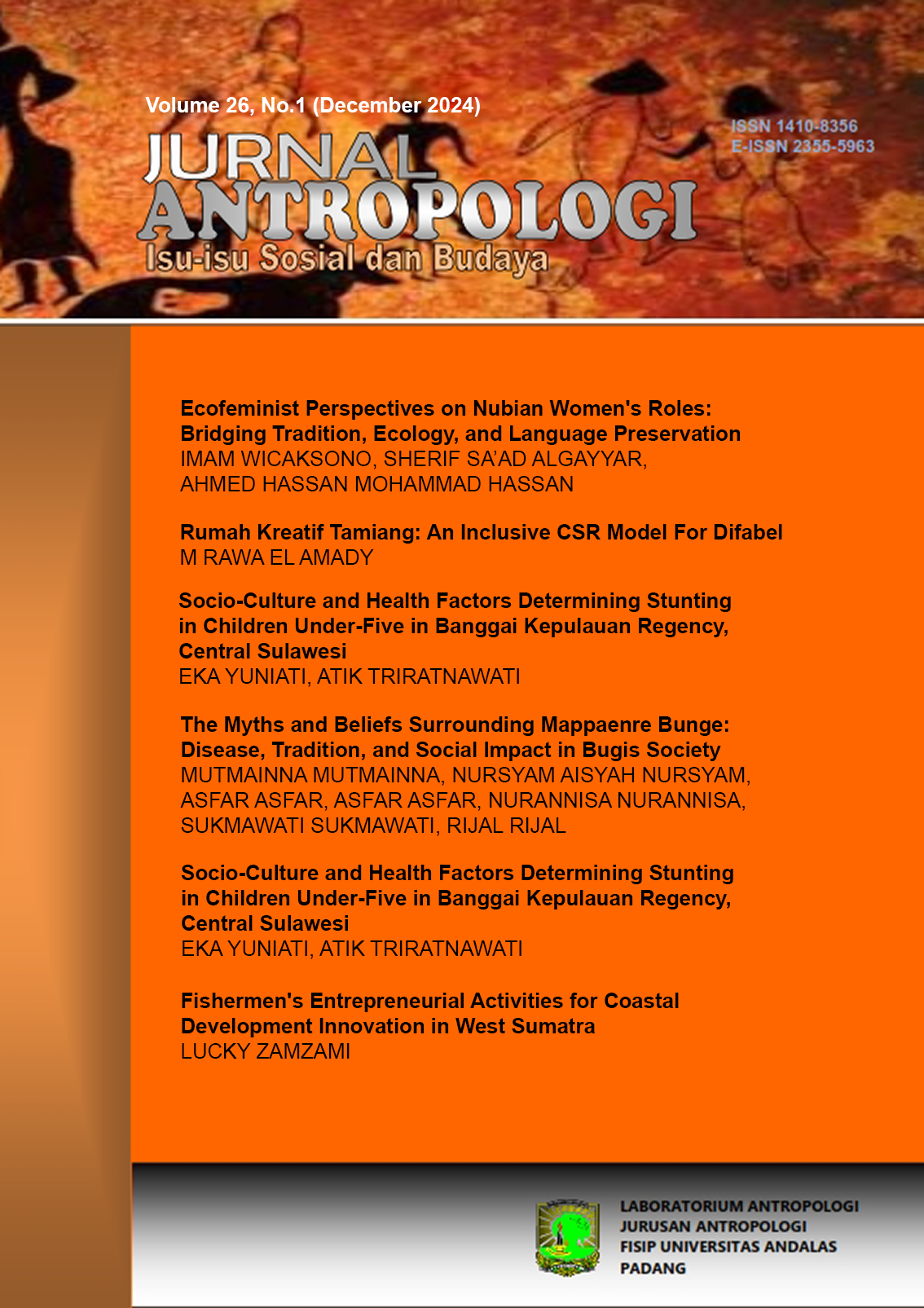
The Myths and Beliefs Surrounding Mappaenre Bunge: Disease, Tradition, and Social Impact in Bugis Society
DOI:
https://doi.org/10.25077/jantro.v26.n2.p213-218.2024Keywords:
Mappaenre Bunge, myth, counter-myth, historical, phenomenologicalAbstract
The Mappaenre Bunge tradition as a ritual that has been going on for generations has deep meaning for the Bugis people. The community believes that by carrying out this tradition, they will establish a harmonious relationship with their ancestors and the universe. People think that if this tradition is not implemented, then people will be affected by disease. The aim of this research is to explore the Mappaenre Bunge tradition in Bugis community culture; examine people's views on counter-myths in the Mappaenre Bunge tradition in Bugis society; and reveal the influence of the Mappaenre Bunge tradition on the emergence of disease in the Bugis tribe. The research methods used are historical methods and phenomenological methods. The historical method is used to collect data about the origins and development of the Mappaenre Bunge tradition, while the phenomenological method is used to understand the experience and meaning of the Mappaenre Bunge tradition for the Bugis community. The results of this research reveal the aim of this research, namely to find out the origins of the emergence of the Mappaenre Bunge tradition; found 6 myths and 3 counter-myths; The myths present in the Tappale Village Community are stronger than the counter-myths.References
Asep. (2000). Kasatuan Adat Banten Kidul: Dinamika Masyarakat dan Budaya Sunda Kasepuhan di Kawasan Gunung Halimun. Tesis Program Pascasarjana, Institut Pertanian Bogor.
Adimihardja, K. (1992). Kasepuhan Yang Tumbuh di Atas Yang Luruh: Pengelolaan Lingkungan Secara Tradisional di Kawasan Gunung Halimun, Jawa Barat. Bandung: Tarsito.
Altieri, M. A., & Nicholls, C. I. (2020). “Agroecology and the Reconstruction of a Post-COVID-19 Agriculture.†The Journal of Peasant Studies, 47(5), pp. 881-898, DOI: https://doi.org/10.1080/03066150.2020.1782891.
Bahagia, Bahagia, et al. (2020). “Local Wisdom to Overcome Covid-19 Pandemic of Urug and Cipatat Kolot Societies in Bogor, West Java, Indonesia.†Forum Geografi 34(2), pp. 146-160.
Bezboruah, K. (2021). “Building and Strengthening Communities: What Works? What Doesn’t?,†dalam M. Stout & A. W. Harrist, (Eds.). (2021). Building Community and Family Resilience: Research, Policy, and Programs. Cham: Springer Nature.
BPS Kabupaten Bogor. (2021). Kecamatan Sukajaya dalam Angka 2021. BPS Kabupaten Bogor.
Colker, Ryan M. (Ed.). (2020). Optimizing Community Infrastructure: Resilience in the Face of Shocks and Stresses. Oxford & Cambridge, MA: Butterworth-Heinemann – Elsevier.
Dewantara, A. (2013). “Peran Elit Masyarakat: Studi Kebertahanan Adat Istiadat di Kampung Adat Urug Bogor.†At-Turas 19(1), pp. 89-117.
Dinas Kebudayaan dan Pariwisata Provinsi Jabar. (2009). Data Kampung Adat di Jawa Barat. Bandung: Disbudpar Provinsi Jabar.
Erik Gómez-Baggethun. (2022). “Is there a future for indigenous and local knowledge?†The Journal of Peasant Studies 49(6), pp. 1139-1157. DOI: https://doi.org/10.1080/03066150.2021.1926994.
Fitriah. N.A. (2021). Dampak Pandemi Covid-19 terhadap Ketahanan Pangan Indonesia: Sebuah Penelitian Eksploratif (Laporan Penelitian). Bogor: Institut Pertanian Bogor.
Hanafi, Imam, dkk. (2004). Nyoreang Alam Ka Tukang, Nyawang Anu Bakal Datang: Penelusuran Pergulatan di Kawasan Halimun, Jawa Barat-Banten. Bogor: Rimbawan Muda Indonesia.
Hoffding, S. & Martiny, K. (2016). “Framing a Phenomenological Interview: What, Why, and How.†Phenomenology and the Cognitive Sciences 15, pp. 539-564. DOI: https://doi.org/10.1007/s11097-015-9433-z.
Grayshaw, P.D. (2021). “Resilient Cities: A Case Study of Tulsa, Oklahoma,†dalam M. Stout & A. W. Harrist, (Eds.). (2021). Building Community and Family Resilience: Research, Policy, and Programs. Cham: Springer Nature.
Iskandar, J. (2012). Ekologi Perladangan Orang Baduy: Pengelolaan Hutan Berbasis Adat secara Berkelanjutan. Bandung: Penerbit Alumni.
Pikobar. (4 Juni 2022). “Sebaran Kasus COVID-19 di Jawa Barat.†Pikobar. Diakses dari laman: https://pikobar.jabarprov.go.id/distribution-case, pada tanggal 4 Juni 2022.
PPID Kabupaten Bogor. (3 Juni 2022). “Data Monitoring Harian Kewaspadaan Infeksi COVID-19Kabupaten Bogor.†PPID Kabupaten Bogor. Diakses dari laman: https://ppid.bogorkab.go.id/?p=57&page_title=Data_Monitoring_Harian_Kewaspadaan_Insfeksi_COVID-19, pada tanggal 4 Juni 2022.
Ristiantri, Y. R. A., et al. (2021). “Rencana Strategis Penentuan Alternatif Rumah Sakit Rujukan COVID-19: Studi Kasus Kabupaten Bogor.†Majalah Ilmiah Globë 23(1), pp. 1-12.
Robins, J. (2018). “Native Knowledge: What Ecologist Are Learning from People Indigenousâ€. Yale Environment 360. Artikel diakses dari laman: https://e360.yale.edu/features/native-knowledge-what-ecologists-are-learning-from-indigenous-people, pada tanggal 4 Juni 2022.
Shiva, V. (2016). Who Really Feeds the World? The Failures of Agribusiness and the Promise of Agroecology. California: North Atlantic Book.
Sugiharto, B. (2019). Kebudayaan dan Kondisi Pasca-Tradisi: Kajian Filosofis atas Permasalahan Budaya Abad 21. Kanisius: Yogyakarta.
M. Stout & A. W. Harrist, (Eds.). (2021). Building Community and Family Resilience: Research, Policy, and Programs. Cham: Springer Nature.
Utomo, L., et. al. (2020). Melihat Covid-19 dari Perspektif Hukum Adat. Jakarta: Lembaga Studi Hukum Indonesia.
Zhafira, A.R. (2019). “Menilik Keberadaan Masyarakat Adat Kampung Urug Bogor di Era Modernisasi.†Academia.edu. Makalah diakses pada laman: https://www.academia.edu/39472265/_Menilik_Keberadaan_Masyarakat_Hukum_Adat_Kampung_Urug_Bogor, pada tanggal 4 Juni 2022.
Downloads
Published
How to Cite
Issue
Section
License
Copyright (c) 2024 Mutmainna Mutmainna, Nursyam Aisyah Nursyam, Asfar Asfar, Asfar Asfar, Nurannisa Nurannisa, Sukmawati Sukmawati, Rijal Rijal

This work is licensed under a Creative Commons Attribution-NonCommercial-ShareAlike 4.0 International License.
The author(s) retain the full copyright over all published articles. By submitting and publishing with Jurnal Antropologi: Isu-Isu Sosial Budaya (JANTRO), the author(s) grant the Department of Anthropology FISIP Universitas Andalas (as the publisher) the exclusive right of first publication.
All articles are licensed under a Creative Commons Attribution-NonCommercial-ShareAlike 4.0 International (CC BY-NC-SA 4.0) license.. This license permits users to copy, distribute, transmit, and adapt the work, provided the original work and source (JANTRO) are properly cited and any derivative work is shared under the same license.
The author(s) are permitted and encouraged to post their work online (e.g., in institutional repositories or on their website) before and during the submission process, as this can lead to productive scholarly exchange and earlier citation of published work.
Department of Anthropology FISIP Universitas Andalas has the right to multiply and distribute the article and every author is not allowed to publish the same article that was published in this journal. Thanks to FISIP Universitas Andalasthat was funded this journal sustainability.
The Copyright Notice should describe for readers and authors whether the copyright holder is the author, journal, or a third party. It should include additional licensing agreements (CC BY-NC-SA)
The manuscript authentic and copyright statement submission can be downloaded ON THIS FORM.
Fill out the form and submit via email or fax to the following address:
Office of Editorial Board Jurnal Antropologi: Isu-Isu Sosial Budaya
Department of Anthropology, FISIP, Universitas Andalas
Building B Department 2nd Floor, FISIP, Universitas Andalas, Kampus Limau Manis, Padang, West Sumatra, 25162, Ph. 0751-71266, Fax: 0751-71266
Email: editor_jantro@soc.unand.ac.id
.png)