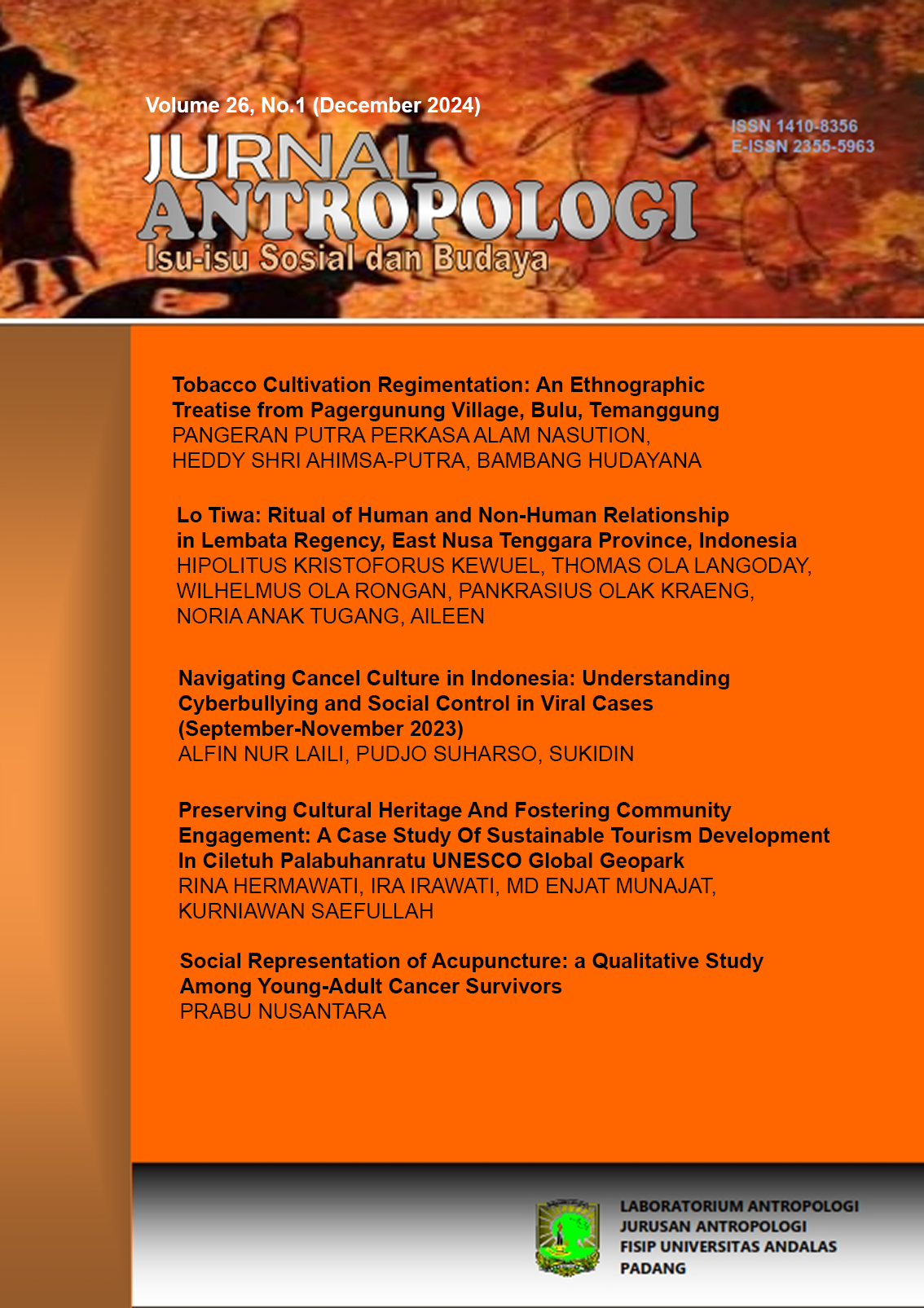
Navigating Cancel Culture in Indonesia: Understanding Cyberbullying and Social Control in Viral Cases (September-November 2023)
DOI:
https://doi.org/10.25077/jantro.v26.n1.p59-67.2024Keywords:
Cancel Culture, Cyberbullying, Social Control, Social Media, Viral casesAbstract
Cancel culture is a phenomenon that creates space for individuals to voice opinions and evaluate behavior that is considered to violate values and norms. Cancel culture can move in two directions, Cyberbullying and Social control. To study cancel culture in Indonesia, there are 5 viral cases (September-November 2023), namely: (1) The case of Pandawara's feud with the Loji Sukabumi Beach government, (2) The ice-cream case by Oklin Fia, (3) The case of abuse committed by members' children. DPR RI, (4) Case of bullying of Cilacap Middle School students, (5) Case of Palestine and Israel. This research explores the direction of cancel culture in Indonesian society, the role of social media and its impact. Using netnography, ten informants were interviewed, and sentiment analysis on Instagram and Analysis using the Naive Bayes model shows that of the 10 social media platforms, 8 of them are cyberbullying and the other 3 are social control. Social media acts as a catalyst for cancel culture in the rapid dissemination of information and the formation of public opinion. The consequences of cancel culture include boycotts, decreased product sales, and prolonged online debates. Frequent misinformation and the instantaneous nature of social media trigger cancel culture, especially cyberbullying, which results in material and mental health losses.References
Albar, J. (2022). Pewarisan Pidato Adat Pasambahan, Studi Kasus Kelompok Aua Sarumpun Kota Padang Panjang [Disertasi]. Universitas Andalas.
Arif, M. (2013). Alua Pasambahan Marobahan Tonggo Niniek Mamak Nagari Koto Nan Gadang. Unpublished.
Arif, M. (2023). Bari Balobe Koto Nan Godang. Fahmi Karya.
Bakar, J. (1997). Sastra Lisan Minangkabau: Tradisi pasambahan helat perkawinan. Pusat Pembinaan dan Pengembangan Bahasa Departemen Pendidikan dan Kebudayaan.
Desembra, F. (2021). Implikatur di dalam Teks Pasambahan Maantaan Siriah di Nagari Salimpat Kabupaten Solok [Disertasi]. Universitas Andalas.
Djamaris, E. (2002). Pengantar Sastra Rakyat Minangkabau. Yayasan Obor Indonesia.
Edly, S., Juita, N., & Tamsin, A. C. (2012). Tradisi Pasambahan Basigorak dalam Adat Perkawinan di Kelurahan Padang Tangah Payobada Kecamatan Payakumbuh Timur: Analisis Struktur, Fungsi, dan Konteks. Jurnal Pendidikan Bahasa Dan Sastra Indonesia, 1(1), 589–599. https://doi.org/10.24036/456-019883
Fanany, I., & Fanany, R. (2003). Wisdom of the Malay proverbs. Dewan Bahasa dan Pustaka.
Fanany, I., & Fanany, R. (2008). Four is Odd Five is Even: The cognitive framework of Malay Proverbs. Dewan Bahasa dan Pustaka.
Fitriza, R. (2018). Model Transfer Pengetahuan Arsitektur Tradisional Rumah Gadang Minangkabau. Jurnal Teori Dan Riset Matematika (TEOREMA), 2(2), 73–84.
Fox, J. J. (2004). Ritual languages, special registers and speech decorum in Austronesian languages. In K. A. Adelaar & N. Himmelmann (Eds.), The Austronesian Languages of Asia and Madagascar. Routledge.
Hakimy, I. (1984). Pegangan penghulu, bundo kanduang, dan pidato alua pasambahan adat di Minangkabau. Remadja Karya.
Jamin, J. (2006). Alur Panitahan Adat Minangkabau. Kristal Multimedia.
Jecki, A. S. (2021). Pengalaman Komunikasi Guru Pasambahan Kajian Fenomenologi tentang Pengajaran Pasambahan di Desa Sikapak Barat Kota Pariaman . Universitas Andalas.
Levi-Strauss, C. (1986). The Elementary Structure of Kindship. Eyre and Spottiswoode.
Mangkuto Rajo, M. (2006). Pasambahan Pidato Adat Minangkabau. Kristal Multimedia.
Navis, A. A. (1984). Alam Takambang Jadi Guru. Pustaka Grafiti Press.
Nelfi, E., Laili, I., & Elfiando, Z. (2022). Deixis in Pasambahan Manjapuik Marapulai in Solok City. Journal of Cultura and Lingua, 3(3), 106–115.https://doi.org/10.37301/culingua.v3i3.102
Ng, C. S. H. (1987). The Weaving of Prestige: Village women’s representation of the social categories of Minangkabau society. the Australian National University.
Ningsi, P. H., Ermanto, E., & Hamidin, H. (2013). Metafora dalam Pasambahan Maanta Marapaulai di Nagari Tanjung Kecamatan Koto VII Kabupaten Sijunjung. Jurnal Bahasa Dan Sastra, 2(1), 72–87. https://doi.org/10.24036/822830
Nofiadri, N. (2021). Rundiang, Minangkabau Ritual Speech: Metaphor, Meaning and Cultural Cognition. Deakin University Australia.
Putriani, M., Abdurahman, A., & Nasution, M. I. (2012). Pasambahan Manjapuik Marapulai pada Upacara Perkawinan di Kenagarian Koto-Tinggi Kecamatan Baso Kabupaten Agam: Analisis Semiotik. Jurnal Bahasa Dan Sastra, 1(1), 51–65. https://doi.org/10.24036/85230
Richards, A. I. (1950). Some types of family structure amongst the Central Bantu. In A. R. Radcliffe-Brown & D. Forde (Eds.), African Systems of Kindship and Marriage. Oxford University Press.
Rosnilawati, R., Ermanto, E., & Novia, N. (2013). Tindak Tutur dan Strategi Bertutur dalam Pasambahan Maantaan Marapulai Pesta Perkawinan di Alahan Panjang Kabupaten Solok. Jurnal Pendidikan Bahasa Dan Sastra Indonesia, 1(2), 461–468. https://doi.org/10.24036/1360-019883
Rubel, P., & Rosman, A. (1996). Structuralism. In D. Levinson & M. Ember (Eds.), Encyclopedia of Cultural Anthropology: Vol. IV. Henry Holt and Company.
Tanjung, S. (2019). Revitalization of Pasambahan Manjapuik Marapulai as Part of Maintaining Efforts of Minangkabau Culture. Journal of Oral Traditions, 1(1), 9–16.
Tussa’diah, H., & Pertiwi, E. (2022). Semiotic Analysis on Pasambahan Manjapuik Marapulai. Proceeding International Conference on Language, Literature, and Culture, 110–123.
Udin, S. (1989). Sastra Lisan Minangkabau: Tradisi Pasambahan pada Upacara Kematian. Departemen Pendidikan dan Kebudayaan.
Widya, N. F. N. (2020). Coherence Discourse Strategy of Pasambahan: Minangkabau Cultural Discourse. Linguistik Indonesia, 38(1), 35–55.
Yusriwal. (2005). Kieh Pasambahan Manjapuik Marapulai di Minangkabau: Kajian estetika dan semiotika. Pusat Pengkajian Islam dan Minangkabau.
Downloads
Additional Files
Published
How to Cite
Issue
Section
License
The author(s) retain the full copyright over all published articles. By submitting and publishing with Jurnal Antropologi: Isu-Isu Sosial Budaya (JANTRO), the author(s) grant the Department of Anthropology FISIP Universitas Andalas (as the publisher) the exclusive right of first publication.
All articles are licensed under a Creative Commons Attribution-NonCommercial-ShareAlike 4.0 International (CC BY-NC-SA 4.0) license.. This license permits users to copy, distribute, transmit, and adapt the work, provided the original work and source (JANTRO) are properly cited and any derivative work is shared under the same license.
The author(s) are permitted and encouraged to post their work online (e.g., in institutional repositories or on their website) before and during the submission process, as this can lead to productive scholarly exchange and earlier citation of published work.
Department of Anthropology FISIP Universitas Andalas has the right to multiply and distribute the article and every author is not allowed to publish the same article that was published in this journal. Thanks to FISIP Universitas Andalasthat was funded this journal sustainability.
The Copyright Notice should describe for readers and authors whether the copyright holder is the author, journal, or a third party. It should include additional licensing agreements (CC BY-NC-SA)
The manuscript authentic and copyright statement submission can be downloaded ON THIS FORM.
Fill out the form and submit via email or fax to the following address:
Office of Editorial Board Jurnal Antropologi: Isu-Isu Sosial Budaya
Department of Anthropology, FISIP, Universitas Andalas
Building B Department 2nd Floor, FISIP, Universitas Andalas, Kampus Limau Manis, Padang, West Sumatra, 25162, Ph. 0751-71266, Fax: 0751-71266
Email: editor_jantro@soc.unand.ac.id
.png)