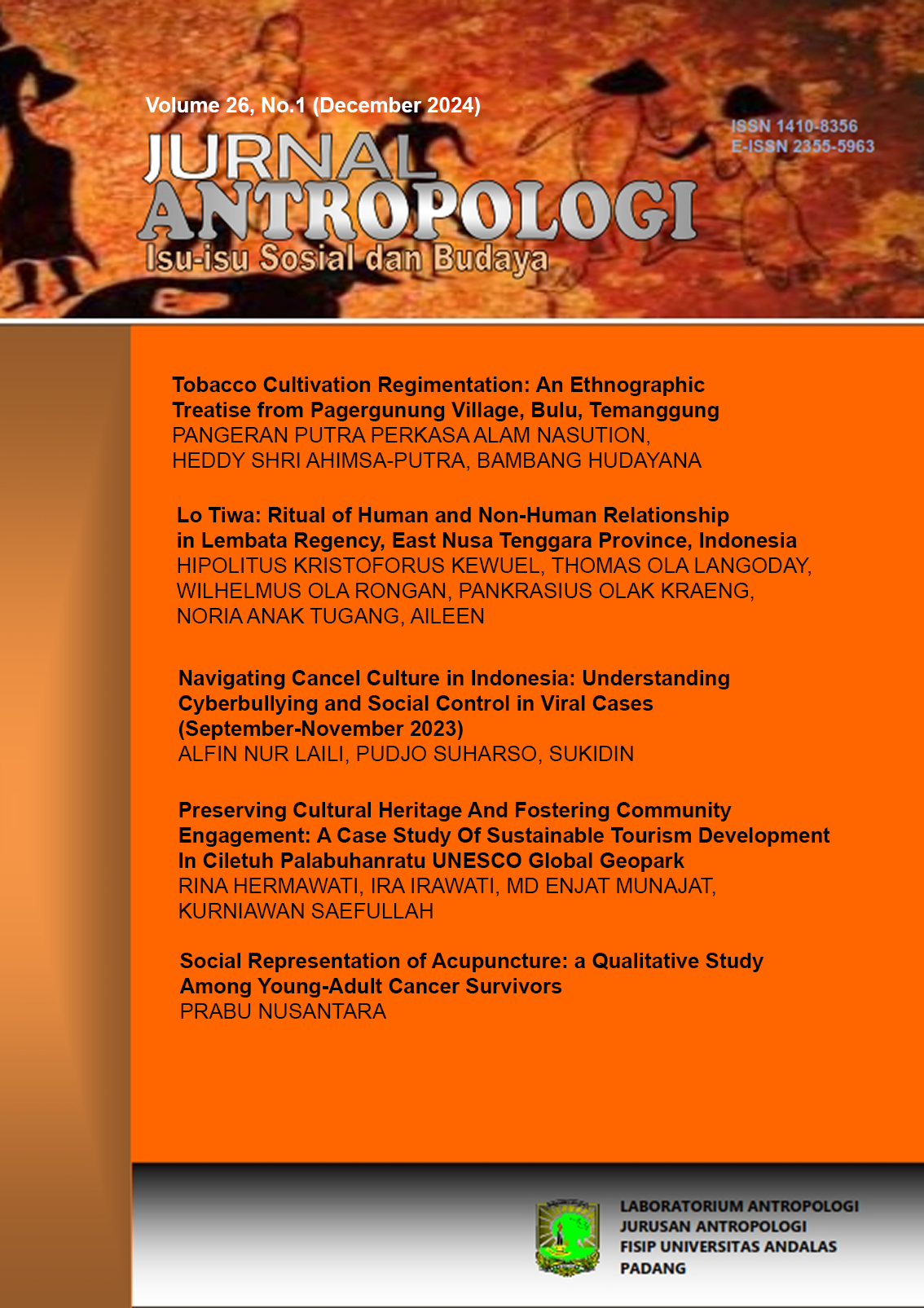
Lo Tiwa: Ritual of Human and Non-Human Relationship in Lembata Regency, East Nusa Tenggara Province, Indonesia
DOI:
https://doi.org/10.25077/jantro.v26.n1.p10-17.2024Keywords:
Lo Tiwa, Plant Pests, Rituals, Human Non-Human Relationship, GovernmentAbstract
This research focuses on the perspective of indigenous ecologies to see how the Lembata people maintain and care for their relationship with nature. The research located in the Lebatukan District highlands area of Lembata Regency in East Nusa Tenggara Province of Indonesia. The Lo Tiwa ritual is carried out by the Lembata people when pests attack their crops. When snails were attacking rice plants, people realized that they could eradicate the slugs through modern ways. However, they also realized that with the pesticide technology, the life of snails was threatened with extinction, which is considered unwise in preserving the local environment. Instead, they raised this issue on the altar of the Lo Tiwa ritual. In this way, preserving the relationship between humans and nature has happened, which is an integral part of environmental studies. Snails as pests are not killed, and rice plants are free from pests. In the Indonesian context, this research finds its context in efforts to promote a culture where the government wants to place culture, including rituals, as one of the essential forces in development. Apart from rituals, other cultural promotion objects include; oral traditions, manuscripts, customs, folk games, traditional sports, traditional knowledge, arts, and languages.References
Bell, Cathrin, 1997. Ritual: Perspectives and Dimensions,
Boyle, Gregory, 2022. Forgive Everyone Everything, Loyola Press.
Dyck, V. A.; Hendrick, J.; Robinson, A. S., 2005. Sterile Insect Technique Principles and Practice in Area-Wide Integrated Pest Management, Springer
Goldstein, H. (1981). Social learning and change: A cognitive approach to human services. New York, NY: Tavistock Publications.
Kewuel, Hipolitus Kristoforus, 2020. Living Deaths: Anthropological Analysis of Death Rites in Paubokol Community, Regency of Lembata, NTT, JANTRO (Jurnal Antropologi: Isu-Isu Sosial Budaya), Vo. 2, No. 2, p. 160-167
Kewuel, Hipolitus Kristoforus, 2022. “Memetik Nilai-nilai Baik dari Ritus-ritus Sare Dame Lembata†https://www.nttsatu.com/memetik-nilai-nilai-baik-dari-ritus-ritus-sare-dame-lembata/
Pearson, Leonard, 1969. Death and Dying: Current Issues in the Treatment of the Dying, Case Western Reserve University
Roose-Evans, James, 1995. Passages of the Soul: Rediscovering the Importance of Rituals in Everyday Life, Elements Books, Ltd.
Rose, H., J., 1950. Myth and Ritual in Classical Civilisation, Brill. Mnemosyne, Fourth Series, Vol. 3, Fasc. 4, pp. 281-287
Rathore, Surya, Manish Chandola, Rupan Raghuvanshi, Manmeet Kaur, and Kundan Veer Singh. 2021. "Indigenous Pest Management Practices of Indian Hill Farmers: Introspecting Their Rationale and Communication Pattern for Secure Ecosystems" Sustainability 13, no. 21: 11608. https://doi.org/10.3390/su132111608
Tavor, O. (2020). Embodying the Dead: Ritual as Preventative Therapy in Chinese Ancestor Worship and Funerary Practices. Journal of Ritual Studies, 34(1), 31–42. https://www.jstor.org/stable/48653857
Turner, Victor; Harris, Alfred; Abrahams, Roger, D., 1969. The Ritual Process: Structure and Anti-Structure,
Undang-undang No. 5, Tahun 2017 Tentang Pemajuan Kebudayaan: https://peraturan.bpk.go.id/Details/37642/uu-no-5-tahun-2017
Wainhouse, David, 2004. Ecological Methods in Forest Pest Management (Oxford, 2004; online edn, Oxford Academic, 1 Apr. 2010), https://doi.org/10.1093/acprof:oso/9780198505648.001.0001, accessed 7 Sept. 2023.
Wawancara dengan Bupati Lembata, Thomas Ola Langoday pada tanggal 24 February 2022
Wawancara dengan Bapak Yakobus Beda pada tanggal 25 Februari 2022
Wawancara dengan Bapak Mikhael Boli pada tanggal 25 Februari 2022
Wawancara dengan Bapak Anton Nuba pada tanggal 25 Februari 2022
Xygalatas, Dimitris, 2022. Ritual: How Seemingly Senseless Acts Make Life Worth Living, Little, Brown Spark
Downloads
Published
How to Cite
Issue
Section
License
The author(s) retain the full copyright over all published articles. By submitting and publishing with Jurnal Antropologi: Isu-Isu Sosial Budaya (JANTRO), the author(s) grant the Department of Anthropology FISIP Universitas Andalas (as the publisher) the exclusive right of first publication.
All articles are licensed under a Creative Commons Attribution-NonCommercial-ShareAlike 4.0 International (CC BY-NC-SA 4.0) license.. This license permits users to copy, distribute, transmit, and adapt the work, provided the original work and source (JANTRO) are properly cited and any derivative work is shared under the same license.
The author(s) are permitted and encouraged to post their work online (e.g., in institutional repositories or on their website) before and during the submission process, as this can lead to productive scholarly exchange and earlier citation of published work.
Department of Anthropology FISIP Universitas Andalas has the right to multiply and distribute the article and every author is not allowed to publish the same article that was published in this journal. Thanks to FISIP Universitas Andalasthat was funded this journal sustainability.
The Copyright Notice should describe for readers and authors whether the copyright holder is the author, journal, or a third party. It should include additional licensing agreements (CC BY-NC-SA)
The manuscript authentic and copyright statement submission can be downloaded ON THIS FORM.
Fill out the form and submit via email or fax to the following address:
Office of Editorial Board Jurnal Antropologi: Isu-Isu Sosial Budaya
Department of Anthropology, FISIP, Universitas Andalas
Building B Department 2nd Floor, FISIP, Universitas Andalas, Kampus Limau Manis, Padang, West Sumatra, 25162, Ph. 0751-71266, Fax: 0751-71266
Email: editor_jantro@soc.unand.ac.id
.png)